Designing Securities for Scrutiny
Brendan Daley , Brett Green , Victoria Vanasco
Based on: Review of Financial Studies, 2023, 36(9), 3693−3737 DOI: https://doi.org/10.1093/rfs/hhad013
Scrutiny doesn’t just reveal information—it unlocks capital.
Share:


Introduction
Firms that raise external funding by selling claims on future cash flows face an information gap: the firm knows more about its future cash flows than outside investors. This information asymmetry can distort capital market allocations and discourage worthwhile projects from being undertaken due to investors’ fear of being sold a “lemon.” Finance theory has traditionally proposed that high-quality issuers can signal credibility by issuing debt claims and retaining a large share of the risky portion of their asset’s payoff to signal confidence. However, holding onto significant risk is costly for firms because it reduces their ability to raise capital and undertake new profitable projects.
Over time, mechanisms that facilitate scrutiny have evolved to help close this information gap. Credit-rating agencies use detailed financial information and employ sophisticated models to estimate default probabilities for bonds and asset-backed securities. An industry of analysts is devoted to evaluating the financial statements of public corporations and assessing the value of their equity. Regulators impose mandatory reporting and disclosure requirements on firms raising capital in public markets. These mechanisms provide potentially valuable information to investors. But how do these various forms of scrutiny affect the firm’s decision of how much capital to raise and what form of securities to issue?
The paper’s central insight is that scrutiny influences both the quantity and the design of the securities being issued. A credible rating or detailed analysis informs investors directly, reducing issuers’ need to rely on costly signaling via retention. This enables high-quality issuers to raise more capital while still receiving favorable pricing. As a result, overall efficiency improves. Moreover, scrutiny encourages high-quality issuers to sell riskier claims to outside investors, confident that third-party validation will affirm their underlying quality.
The Theory
When a security’s designer has positive information about future cash flows, they want to credibly convey this to potential investors. Consider first a market without additional scrutiny, in which investors only have the decision of the issuer to go on. High-quality issuers sell debt while retaining the residual equity, using the design’s sensitivity to asset quality as a signal. Upside retention, which is more likely to materialize with high-quality assets, communicates confidence. Low-quality issuers, lacking such confidence, instead sell the entire cash flow to avoid the associated risk. Investors correctly infer issuer quality from the securities being issued and prices perfectly reflect the quality of underlying assets.
Scrutiny fundamentally alters these predictions. Investors now update their beliefs based not only on the security’s structure but also on what is revealed by the scrutiny. The intensity of the scrutiny is the key determinant of the issuers’ behavior.
With little to no scrutiny, the traditional signaling logic holds: high-quality issuers sell debt and retain the equity. This is illustrated in the figure below when the intensity of scrutiny is below  and high-quality issuers sell debt with a face-value of
  . For intermediate levels of scrutiny (between
  and
and  ), high-quality issuers still sell debt, but they sell more of it (i.e., the face value increases), meaning that they raise more capital. With even more scrutiny (above
  ), the signaling strategy flips. Now, the most credible signal is to offer the informationally sensitive portion—the equity—to outside investors. By doing so, high-quality issuers expose themselves to scrutiny risk, signaling strong confidence that external analysis will validate their private information. The figure also illustrates that costly retention decreases with the intensity of scrutiny. As scrutiny increases from
  to
to  , the issuer retains less equity. Above
  , the issuer retains only the safest portion of the cash flow (i.e., the debt), with a face value that is decreasing in the intensity of scrutiny.
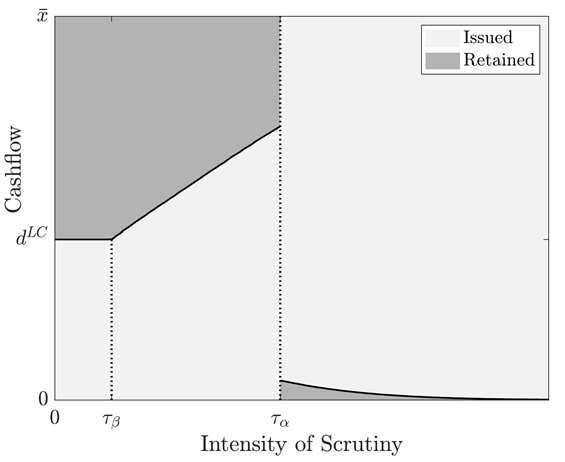
Paradoxically, scrutiny can reduce the total amount of information revealed to investors and result in less informative prices. In a no-scrutiny world, the security offered conveys the issuer’s private information, which is incorporated into the market price. But with sufficient scrutiny, issuers are not compelled to fully differentiate themselves with the security issued because they can rely on the outcome of scrutiny. This leads to an equilibrium with pooling: some low-quality issuers offer the same security as high-quality issuers. As a result, investors can no longer infer the issuer’s private information from the security issued. While scrutiny conveys additional information, because it is imperfect, there is less overall information revealed to investors than in the no-scrutiny benchmark.
In practice, the level of scrutiny a security receives depends on its size and risk. Larger or riskier deals tend to attract more attention from analysts, credit rating agencies, and investors. This creates a feedback loop: more scrutiny makes it easier for high-quality issuers to raise capital with less need to retain risk, which encourages more issuance. At the same time, increased issuance draws even more scrutiny. However, this cycle can break down. If issuers expect scrutiny to be low, the market can get “stuck” in a state of low activity and limited scrutiny. To address this, regulators should consider strengthening disclosure requirements and increasing oversight of credit rating agencies. Doing so would give high-quality issuers the confidence to design securities that invite deeper due diligence and help activate the positive feedback loop.
Understanding the Real World
The paper’s predictions align with empirical evidence showing that external scrutiny reduces issuers’ reliance on retaining risky payoffs. For instance, firms with reputable credit ratings borrow more on better terms, suggesting that third-party opinions ease investor concerns. In addition, firms with more analyst coverage are more likely to issue equity—suggesting that they feel less need to offer safer claims to skeptical investors. These findings are consistent with the paper’s model: trusted scrutiny allows high-quality issuers to rely less on costly cash flow retention. Offering riskier claims is no longer penalized when backed by credible external validation. Scrutiny substitutes for costly retention by doing the job of signaling—separating confident sellers from those who fear exposure.
Conclusion
This paper provides a framework for understanding how private information, strategic security design, and market scrutiny interact. Scrutiny can enhance efficiency by reducing the need for excessive signaling via costly retention, and also shapes security design by incentivizing issuers to switch from selling debt to selling equity claims. Simultaneously, it may reduce the informativeness of security design and thus prices. Policymakers should recognize these layered effects when crafting disclosure rules, credit rating standards, or analyst coverage regulations. The goal is to strike a balance—supporting effective signaling, and thus trade and price informativeness—to promote the overall health and efficiency of capital markets.