The Hidden Logic of Letting Firms Fail
Samuel Antill , Christopher Clayton
Based on: “Crisis Interventions in Corporate Insolvency,” 2025, Journal of Finance, 2025, 80(2), 875–910
Every crisis triggers the same instinct: keep failing firms alive. When is that instinct wrong?
Share:


When a financial crisis hits, governments face an immediate and difficult question: should failing companies be saved or shuttered? During COVID-19, policymakers across Europe and the United States reached for policies to prevent liquidations: eviction moratoriums, bankruptcy holidays, emergency loans to keep distressed businesses alive. Broadly speaking, such policies “tax liquidation” – they are designed to encourage lenders to keep distressed firms afloat. Japan, by contrast, took a different path during its nonperforming loan crisis in the 1990s. The Takenaka Plan, named for the minister who implemented it, essentially pushed banks to force insolvent firms into liquidation rather than propping them up. These policies “subsidize liquidation.” Two crises. Two opposite responses. Which was right?
The answer from economic theory is counterintuitive: both responses can be appropriate. What determines the right call is not only the severity of the corporate distress, but the health of the banks absorbing it. This finding has important implications for how governments respond to future crises.
To understand this result, consider a simplified representation of what banks do during a crisis. They hold loans to two kinds of firms: healthy firms that need new investment financing, and distressed firms that need support simply to survive. A bank can choose to reorganize a failing firm, covering its operating losses in exchange for a claim on its future value, or liquidate it, selling its assets to a third-party buyer at a discounted price. Both choices carry costs. Reorganization ties up scarce bank funds in weak firms. Liquidation depresses asset prices across the board: when many firms are sold off at once, buyers know they have the upper hand and pay less. This matters because banks pledge their loan portfolios as collateral when borrowing from depositors and other lenders. Lower asset prices mean lower collateral values, which means less borrowing capacity, and ultimately less lending to everyone. Economists call this a “fire-sale externality.” The key insight from economic theory is that banks, acting privately, do not account for how their decisions affect other banks. They ignore the impact of liquidations on other banks, the fire-sale externality described above. Prior research shows that policy makers should tax liquidations (i.e., discourage liquidations) to counteract this fire-sale externality.
Importantly, in addition to the fire-sale externality, banks also fail to internalize how reorganizations may negatively affect other banks. When a bank reorganizes a failing firm, it diverts lending capacity away from healthy firms. In the aggregate, this pushes up interest rates economy-wide as healthy firms compete for scarce loanable funds. The increase in interest rates in turn erodes the value of other banks’ loan portfolios, which they use as collateral to enable borrowing for their own lending activities. This contracts the borrowing and lending capabilities of other banks, pushing up interest rates even more. Banks do not internalize this “collateral congestion externality’’ of reorganization. A social planner — a government deciding whether to tax or subsidize liquidations — should.
Figure 1: Motives to Tax or Subsidize Liquidations
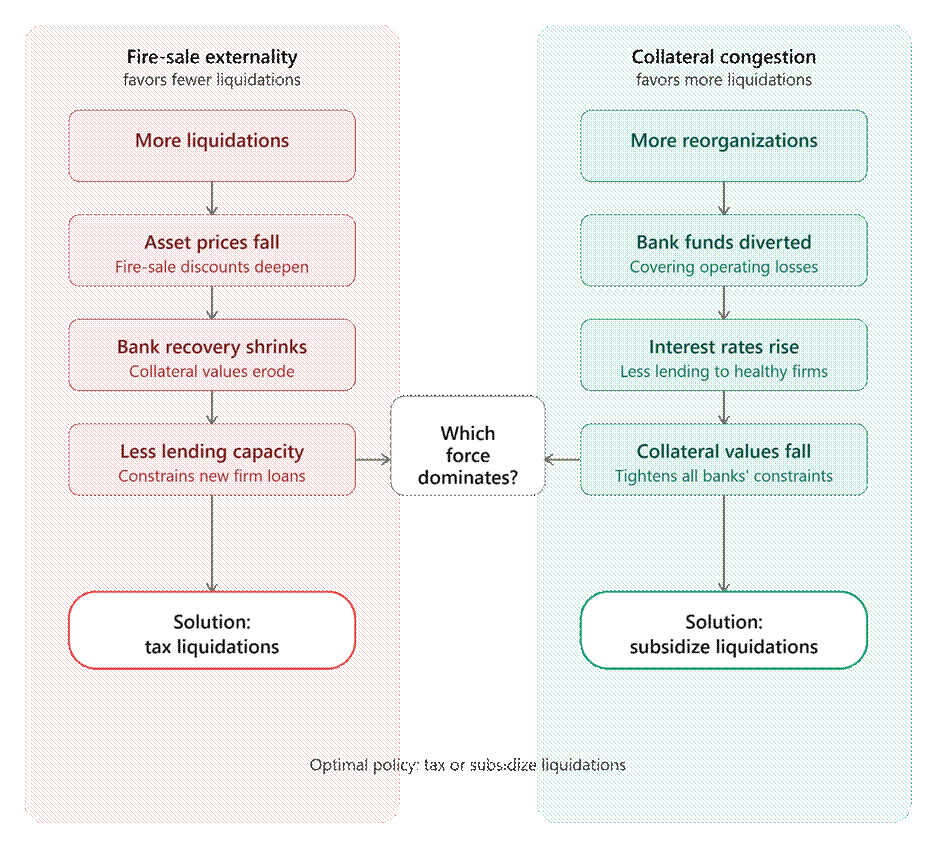
Given the presence of competing regulatory incentives, under what conditions should a planner encourage liquidation rather than reorganization? Four factors point toward liquidation subsidies. First, high corporate leverage: when firms carry a lot of debt and banks’ outstanding loan portfolios are larger, there is more collateral at stake that can be revalued, making the collateral externality from reorganization particularly costly. Second, high operating losses: distressed firms that consume large amounts of ongoing financing make reorganization especially burdensome for bank balance sheets. Third, low firm productivity: when the shock affecting the economy looks permanent rather than temporary — as it did in Japan — the long-term value of reorganized firms is low, further tipping the balance toward liquidation. Fourth, and most surprisingly, severe fire sales: when liquidation prices are already deeply depressed, the marginal cost of additional liquidations falls even as the benefit of freeing up bank lending capacity rises. The marginal cost falls because, under severe fire sales, liquidation proceeds are already deeply discounted—so the primary benefit of each additional liquidation is not the sale price itself, but the capital freed from the existing loan. Exacerbating an already-severe fire sale therefore carries little downside: it reduces proceeds that are already negligible, while the benefit of releasing that capital remains fully intact.
This last result is especially striking. Most discussions of financial crises assume that large fire sales are an argument against liquidation: if selling distressed assets drives prices down further, why push for more liquidations? The answer is that under already-low prices, the cash saved by avoiding operating-loss obligations outweighs the harm from further price declines. The planner should lean into the fire sale, not fight it.
Applying this framework to the two historical crises sheds light on the different responses by the US and Japan. Japan's crisis featured high corporate leverage, heavy reliance on bank lending, lower GDP growth (suggesting a more permanent shock), and lower corporate profitability. All four indicators point in the same direction: liquidation subsidies were the right call for Japan. The United States during COVID looked opposite on all four dimensions, pointing toward reorganization subsidies — precisely what policies like the CARES Act provided.
An important concern with interventions in the resolution process is that governments may have little capability to assess the value of different firms, and so be ill-equipped to intervene. Conveniently, theory shows that the optimal intervention does not require the government to assess the viability of any individual firm. A uniform tax or subsidy on liquidations — calibrated to aggregate indicators of corporate distress and banking-sector health — is sufficient to improve on private outcomes. Governments do not need to pick winners and losers. They need to read the balance sheet of the economy.
The framework also clarifies how insolvency policy interacts with other tools. Macroprudential regulation — requiring banks to hold more equity before a crisis hits — is most valuable in exactly the situations where liquidation subsidies are desirable, namely when the social value of bank lending capacity is highest. Bailouts to banks dominate bailouts to individual firms because banks can amplify each dollar of support through their lending multiplier---the additional funds they raise by pledging a loan as collateral.
Because banks are heterogeneous in their activities, our model highlights that the policy response during a crisis can be different across different banks. For example, banks can differ in the severity of their binding collateral constraints. During a crisis, the trade-off highlighted by theory results in a policy prescription whereby banks should specialize in their comparative advantage. Banks with difficulty collateralizing loans should become “distressed lenders” that focus on restructuring distressed firms, whereas banks with more collateralizability should instead liquidate more firms and focus on new lending. Debt subordination schemes can help in such situations by directing value to where it best offsets these competing externalities, which can both coexist in the same crisis due to differences in bank collateral constraints.


