Filing for Bankruptcy Early Can Keep a Firm Alive Longer
Based on: “Dynamic Coordination and Bankruptcy Regulations,” Review of Financial Studies, 2026, 39(4), 1116–1176
Sometimes, the best way for a firm to survive longer is to commit to fail sooner. And clawing back repayments made just before bankruptcy may work even better.
Share:


Background
When a company starts to look vulnerable, creditors have a strong incentive to run by pulling their money out quickly. Nobody wants to be the one left holding an empty claim after others have already been repaid. That collective panic can turn a manageable financial problem into a full-blown collapse.
The 2023 depositor runs on First Republic Bank, Silicon Valley Bank, and Signature Bank showed how quickly confidence can unravel once creditors fear being last in line. What begins as concern about a firm’s health can become a race for the exit.
Bankruptcy law is meant to contain exactly this kind of disorderly scramble. Two provisions stand out. The first is the automatic stay: once a firm files for bankruptcy, individual creditors can no longer race to seize assets on their own and must instead wait for a collective court-supervised process. The second is the avoidable-preference rule: repayments made to some creditors shortly before bankruptcy can be clawed back and redistributed.
These rules are usually seen as tools for handling failure after it happens. But their bigger effect may come earlier. They shape how creditors behave before the firm fails, and that behavior helps determine whether the firm collapses more quickly or survives longer.
Early Bankruptcy Can Make Creditors More Patient
Once bad news arrives, each creditor faces a simple choice: stay a little longer and earn more interest, or pull out before others do. Staying promises a higher return, but it also raises the risk of being trapped in bankruptcy. Whether creditors wait or run depends on what they expect to recover if bankruptcy happens. That is why the timing of a bankruptcy filing matters so much.
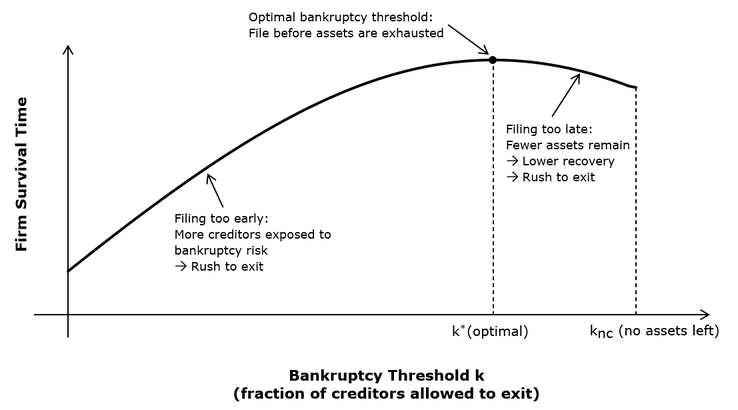
If a firm files late, more creditors manage to escape beforehand. At first glance, that seems reassuring because each creditor is less likely to end up trapped in bankruptcy. But there is a catch. By the time the filing finally happens, the firm may have already paid out so much that little value is left for those who remain. If the firm files earlier, more creditors are exposed to bankruptcy risk. But more assets are preserved inside the firm, so recoveries in bankruptcy are higher.
This creates a tradeoff. Filing too early makes creditors nervous because too many of them risk getting caught. Filing too late also makes them nervous because there is little value left to divide once bankruptcy occurs. Somewhere in between lies the sweet spot: a filing date early enough to preserve value, but not so early that it triggers immediate panic.
This is the logic behind the hump-shaped pattern shown in the figure below. Firm survival is longest not when bankruptcy is postponed to the bitter end, but when the firm is expected to file while it still has some value left.
This has a striking implication for the automatic stay. Without it, bankruptcy becomes a pure first-come-first-served scramble: creditors who move first get paid, while those who wait get little or nothing. That is exactly the sort of prospect that fuels a run. The automatic stay changes the calculation by forcing creditors to share what remains. Because expected recoveries in bankruptcy improve, it can make them more willing to stay put beforehand. In other words, a rule designed for the aftermath of failure can stabilize behavior long before failure occurs.
Why Clawbacks Can Work Even Better
There is, however, an obvious practical problem with relying on firms to file early. Managers often have every reason to delay. Bankruptcy can cost them control, reputation, and often their jobs. A policy that depends on firms voluntarily filing may therefore be unrealistic. That is where avoidable preference becomes especially valuable.
This rule, which appears in nearly half of large U.S. bankruptcy cases, allows the court to claw back repayments made shortly before bankruptcy. It has been used in prominent collapses including General Motors, WorldCom, and Lehman Brothers. The idea is simple but consequential: if creditors know that withdrawing their money shortly before bankruptcy may not let them keep it, the incentive to run weakens. Clawbacks can work even better than the firm’s own promise to file early.
An example makes the point clearly. Start with one approach: the firm credibly commits to file for bankruptcy once 50% of creditors have exited. Production stops at that moment, while the firm still has assets. Now consider a second approach: the firm keeps operating until all assets are depleted, allowing 80% of creditors to exit. But the regulator claws back repayments made to the last 30% who withdrew. Those creditors are effectively pushed back into the bankruptcy pool along with the 20% who never left.
In both cases, only 50% of creditors ultimately escape bankruptcy exposure, so each creditor faces the same odds. But the second arrangement allows the firm to continue operating until bankruptcy interrupts production. This preserves more total value and improves expected recoveries, making creditors more willing to remain invested in the first place.
This is the key advantage of clawbacks over a firm’s own promise to file early: by reallocating payoffs after bankruptcy is filed, the bankruptcy court can discourage creditor runs just as effectively, without stopping production as early.
A Surprisingly Simple Policy Lever
There is an additional practical benefit. The ideal clawback window—the period before bankruptcy during which repayments can be reversed—does not depend on all the messy, firm-specific details one might expect. For example, it does not hinge on the firm’s leverage or the productivity of its assets near bankruptcy. Instead, it depends on two broader forces: how quickly news of distress spreads among creditors, and the interest rate promised on the debt.
If bad news travels fast, creditors can coordinate their exits more quickly, so a longer clawback window is needed to blunt the run. If interest rates are higher, repayments accumulate faster, so clawbacks bite harder even over a shorter window.
This makes the avoidable-preference rule a surprisingly “detail-light” policy tool. Regulators do not need a bespoke bankruptcy rule for each distressed firm. A common clawback window can be set using observable market-wide conditions rather than hard-to-measure firm-level fundamentals.
The Lesson Goes Beyond Corporate Bankruptcy
The same logic applies outside traditional corporate bankruptcy. Bank regulation faces an almost identical problem: intervene too late and the institution is stripped bare by withdrawals; intervene sufficiently early and confidence may hold longer. The Federal Reserve’s own post-mortem on the 2023 regional bank failures argued that supervisors should have acted faster. That message fits the broader lesson here.
The bigger point is easy to miss but important to remember: bankruptcy law does not just determine what happens after a firm fails. It shapes what creditors expect while the firm is still alive. These expectations influence whether they stay patient or rush for the door. Ultimately, therefore, the design of bankruptcy rules can affect how long distressed firms survive in the first place.
The central lesson is counterintuitive but powerful: committing to bankruptcy earlier can help distressed firms survive longer. And court-ordered clawbacks of repayments made just before bankruptcy may work even better.


